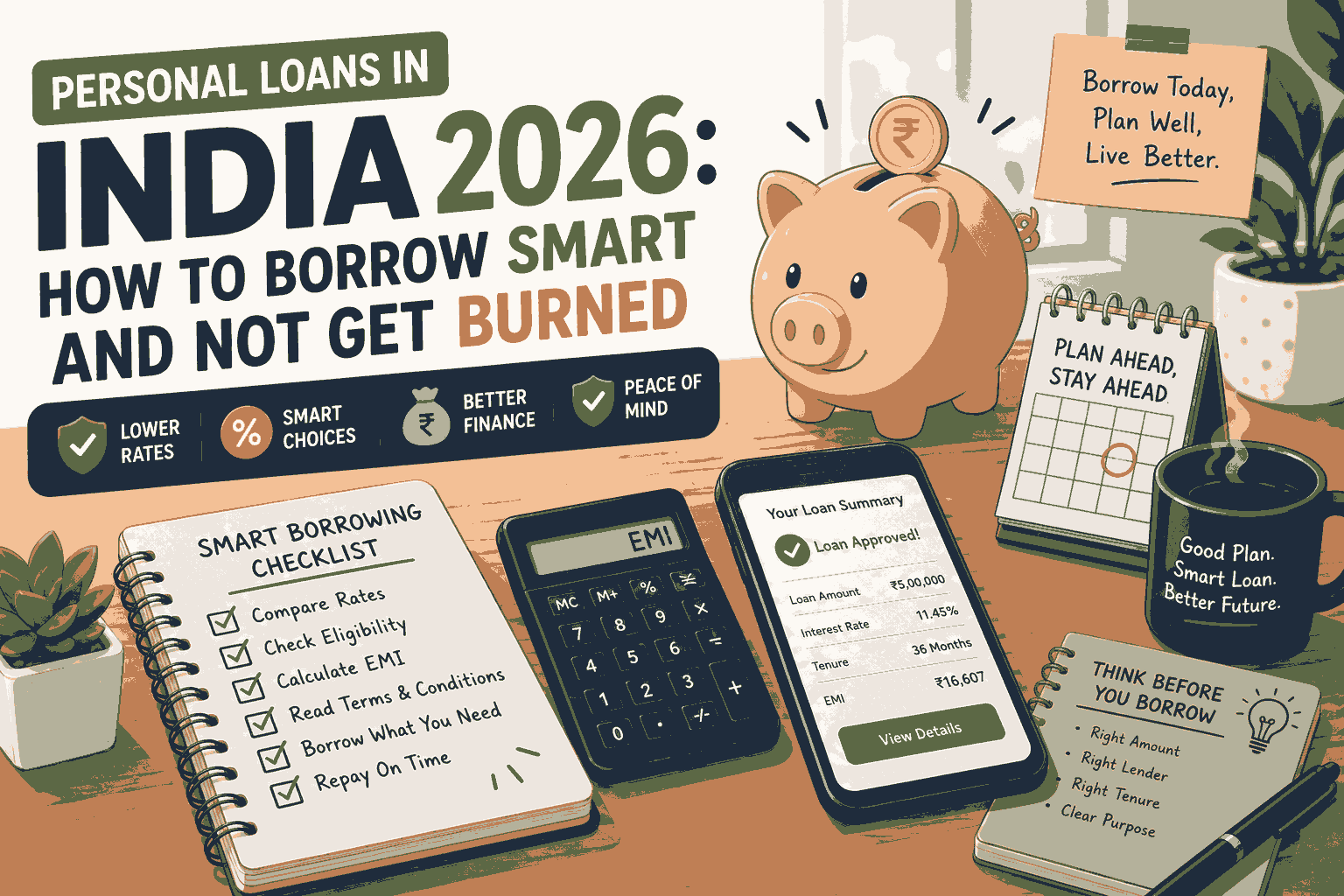
Personal Loans in India 2026: How to Borrow Smart and Not Get Burned
Meta Description: Compare personal loan interest rates from SBI, HDFC, ICICI, Bajaj Finance and more. Real numbers, honest advice on EMI, CIBIL score, and how to avoid the traps most borrowers fall into.
Taking a personal loan in 2026 is easier than ever. You can get ₹5 lakh in your account in under 2 hours without leaving your house. That convenience is also what makes it dangerous — because "easy money" is exactly when people borrow too much, ignore the fine print, and spend the next three years paying 24% interest on a loan they took for a wedding or a phone.
This isn't a list of banks. You'll find the numbers you need below, but the bigger job here is helping you borrow correctly — right amount, right lender, right tenure.
Why the interest rate you're offered isn't random
Banks don't offer everyone the same personal loan rate. The 10.85% you see advertised is the floor — what they give their best customers. What you actually get depends on:
Your CIBIL score — this is the biggest lever. A 780 score might get you 11.5% at HDFC. A 680 score at the same bank gets you 19% — or outright rejection.
Your employer — banks have internal lists of companies they trust. If you work at TCS, Infosys, a government department, or a listed company, you're low-risk to them. Freelancers and small business owners pay more.
Your existing relationship — if your salary account is with HDFC and you've been there 5 years with zero overdrafts, you'll get a pre-approved offer at a better rate than a new customer walking in.
Your debt-to-income ratio — if you're already paying ₹20,000/month in EMIs on a ₹35,000 take-home salary, no bank will give you more credit, regardless of your CIBIL score.
Knowing this matters because the right strategy isn't "apply everywhere and see who approves." Every application triggers a hard enquiry on your CIBIL report and temporarily drops your score. Apply to the wrong 3 lenders and you've damaged your profile for 6 months.
Current personal loan interest rates (2026)
Here's where the major lenders actually stand. These are real ranges — the low end requires excellent credit and a strong banking relationship:
Public sector banks
- SBI Xpress Credit: 11.45% – 14.00%
- Bank of Baroda: 11.05% – 18.75%
- PNB: 11.40% – 16.95%
SBI is consistently the best option for government employees and PSU staff. If you fall in that category and you're shopping anywhere else first, you're leaving money on the table.
Private banks
- HDFC Bank: 10.85% – 24.00%
- ICICI Bank: 10.85% – 16.25%
- Axis Bank: 11.25% – 22.00%
- IndusInd Bank: 10.49% – 26.00%
The spread on private bank rates is wide because they serve a much broader risk profile. An IndusInd customer at 10.49% and an IndusInd customer at 26% are very different people.
NBFCs (Non-Banking Financial Companies)
- Bajaj Finance: 11.00% – 30.00%
- Tata Capital: 10.99% – 28.00%
- Poonawalla Fincorp: 9.99% – 24.00%
Poonawalla consistently offers some of the lowest rates among NBFCs and has improved significantly since the RBI licensing. Worth checking if you're self-employed and getting rejected by traditional banks.
The EMI trap most people walk into
The loan app approves you for ₹8 lakh. You needed ₹5 lakh. You take ₹8 lakh because it's approved anyway and "you might need it."
That extra ₹3 lakh at 14% over 4 years costs you ₹91,000 in additional interest. For money you didn't need.
Borrow exactly what you need. Then pick the shortest tenure you can afford without straining your monthly budget.
On ₹5 lakh at 12%:
- 12-month EMI: ₹44,424/month — total interest: ₹33,088
- 36-month EMI: ₹16,607/month — total interest: ₹97,852
- 60-month EMI: ₹11,122/month — total interest: ₹1,67,320
The 60-month EMI feels comfortable. But you pay ₹1.34 lakh more in interest compared to 36 months. That's the comfort tax.
A reasonable rule: your total EMI obligations across all loans should not exceed 40% of your net monthly take-home. If you're crossing that, you're overleveraged regardless of whether banks are willing to lend you more.
CIBIL score and what it actually takes to move it
If your score is below 700 right now, you won't get a good rate anywhere. The question is how fast you can fix it.
What moves the needle most, in order of impact:
Missed payments — even one 30-day-late payment can drop your score 60–90 points. Automate every EMI and credit card payment. Not "set a reminder" — actual auto-debit.
Credit utilization — if your credit card limit is ₹1 lakh and you're regularly using ₹70,000+ of it, that signals to CIBIL that you're dependent on credit. Keep it under 30%. If your limit is ₹1 lakh, don't let your monthly spend cross ₹30,000 before the billing date. Pay mid-cycle if needed.
Age of accounts — closing your oldest credit card hurts your score because it shortens your credit history. Keep old accounts open even if you barely use them.
Multiple hard enquiries — each loan or card application you make causes a hard pull. If you applied to 5 places last month and got rejected everywhere, your score took a hit from the enquiries alone before any rejection factored in.
CIBIL scores are calculated monthly. With consistent on-time payments and low utilization, a score in the 650–680 range can realistically hit 730–750 in about 9–12 months.
Instant loan apps: the good, the bad, and the predatory ones
Yes, you can get ₹50,000 in your account in 10 minutes from a loan app. Some of them are legitimate NBFCs regulated by the RBI. Many are not.
The legitimate ones worth considering:
- Navi — starts at 9.9%, RBI-registered NBFC, clean app experience
- MoneyTap — credit line model, you pay interest only on what you use
- Fibe (formerly EarlySalary) — designed for salaried professionals, decent rates for short tenures
Red flags for loan apps to avoid:
- No NBFC registration visible in the app or website
- Demand your full contact list access as a "loan condition" (this is how recovery harassment works)
- Interest rates shown as "weekly" or "per day" rather than annual percentage
- Processing fees deducted upfront before disbursal of a small loan
- No physical address or grievance officer listed
If an app is not on the RBI's registered NBFC list, don't use it. You can check at rbi.org.in.
Personal loan vs business loan — the decision is simpler than it looks
If you need money for your business and you're a sole proprietor or small business owner, you'll often be tempted by personal loans because the approval is faster and simpler.
For amounts below ₹10 lakh and when you need funds in 24 hours — personal loan makes sense. Above that, the interest difference and the tax deductibility of business loan interest (it's a business expense, directly reducing your taxable profit) usually makes a business loan more efficient.
The downside of business loans: more paperwork. Two to three years of ITR, bank statements, GST returns, business registration. If your records are clean and current, worth the 2–3 extra days. If your ITR is filed late or your books are messy, personal loan is your only realistic option anyway.
For small business owners who keep getting rejected by banks, check PM MUDRA Yojana — government-backed MSME loans up to ₹10 lakh through PSU banks and MFIs at significantly lower rates than any NBFC.
Before you apply: things that seem minor but actually matter
Check for pre-approved offers first. Log into your bank's app (SBI YONO, HDFC mobile banking, ICICI iMobile). Pre-approved offers are based on your existing relationship — they come with better rates, instant disbursal, and no hard enquiry until you actually accept.
Read the prepayment clause. Most personal loans have a prepayment penalty of 2–5% of outstanding principal if you pay off early within the first 12–18 months. If you're likely to have extra cash in a year (bonus, family money), factor this in. Some lenders — Bajaj Finance's Flexi Loan, for example — allow partial withdrawals and repayments with no penalty.
Processing fee is negotiable at banks (not NBFCs). If you're borrowing ₹15 lakh from HDFC and they quote a 2% processing fee, that's ₹30,000. For high-value customers with salary accounts, banks routinely waive or halve this. Just ask.
The EMI start date matters. Loans disbursed mid-month often have a "stub period" where you pay interest for the partial month before your first full EMI starts. A ₹10 lakh loan at 12% disbursed on the 15th means ₹4,110 interest for that half-month before EMI 1. Not a disaster, but know it's coming.
The one question to ask yourself before you apply
Can you afford this EMI even if your income drops 20% for 3 months?
Job loss, medical emergency, business slowdown — any of these can happen mid-loan. Banks are not sympathetic. The EMI is due regardless of your circumstances. If the answer is "no, I'd struggle," either borrow less or build a small emergency fund (2–3 months of EMI value) before you take the loan.
If the answer is yes, borrow confidently. A personal loan at a reasonable rate from a legitimate lender, used for a clear purpose, is a perfectly sensible financial tool. It's only the fuzzy "I'll figure out what I need it for" borrowing that causes problems.